
Barclays & Citi Global Offers – Established Multinational Strength in 2026

When most people think about credit card approval, they focus on two variables: income and credit score. While both are important, they represent only part of the evaluation process. In 2026, banks — especially global and digital institutions — rely on increasingly sophisticated internal systems that analyze behavioral patterns, risk exposure, and profile stability beyond simple financial metrics.
Understanding how these systems work does not guarantee approval. However, it significantly improves how you position your application. Instead of treating approval as a mystery, you can view it as a structured risk assessment process.
Approval decisions are rarely based on a single number.
They are based on patterns.
Your credit score acts as an entry filter. It provides a snapshot of your borrowing history, repayment consistency, and credit exposure. However, banks do not evaluate your score in isolation.
They examine:
• Recent changes in your score
• Trends in utilization
• Inquiry frequency
• Account longevity
• Payment consistency
A stable score with consistent behavior often carries more weight than a fluctuating score, even if the latter is numerically higher.
In 2026, many global banks are placing increased emphasis on behavioral stability over raw scoring alone.
Utilization refers to how much of your available credit you are using. High utilization may signal financial stress, while low and consistent utilization suggests disciplined management.
Banks often analyze:
• Overall utilization ratio
• Utilization spikes in recent months
• Exposure across multiple institutions
• Balance growth patterns
Even if your income is strong, consistently high utilization can increase perceived risk.
Digital banks, in particular, rely heavily on automated utilization analysis as part of their risk modeling.
One of the most overlooked approval factors is inquiry behavior. Applying for multiple credit products within a short period can trigger internal sensitivity.
Banks monitor:
• Number of recent inquiries
• Frequency of credit applications
• Timing between submissions
• Cross-product exposure
If multiple applications appear within a compressed window, internal models may interpret that as elevated risk.
Spacing applications thoughtfully can improve profile perception.
Many global institutions assess not only your standalone profile, but also your broader exposure within their ecosystem.
For example:
• Do you already hold accounts with the institution?
• Is your existing exposure balanced?
• Have you demonstrated long-term stability?
Traditional multinational banks such as HSBC, Barclays, Citi, and American Express may factor internal relationship history into approval decisions.
Digital banks may rely more heavily on behavioral data and external signals.
Approval systems are not static. They adapt based on broader market conditions and internal portfolio performance.
During expansion phases, banks may operate with slightly more flexible internal thresholds. During periods of risk adjustment, sensitivity may increase quietly.
This does not mean approval becomes impossible.
It means evaluation criteria may shift subtly in response to external factors.
Understanding this dynamic reinforces why timing and positioning matter.
Digital-first institutions such as Revolut, Wise, Monzo, and N26 increasingly use automated risk engines to assess applications in real time.
These systems evaluate:
• Identity verification consistency
• Transaction patterns (when available)
• Behavioral data points
• External credit bureau signals
Automated evaluation allows faster decisions, but it also means data inconsistencies can trigger immediate rejection without manual review.
Ensuring profile consistency becomes critical.
Income is important, but it is assessed relative to:
• Debt obligations
• Existing credit exposure
• Stability of earnings
• Geographic cost considerations
A high income with high debt exposure may present more perceived risk than moderate income with low exposure and stable behavior.
In 2026, contextual income assessment is more common than simple threshold evaluation.
One recurring theme across institutions is consistency.
Banks favor profiles that demonstrate:
• Predictable repayment behavior
• Controlled credit utilization
• Moderate inquiry frequency
• Long-term account stability
Perfection is not required.
Stability is preferred.
This is especially true in environments where internal models adjust dynamically.
Approval decisions are layered.
They combine score context, utilization trends, inquiry patterns, relationship history, macro conditions, and automated risk modeling.
Rather than focusing exclusively on income or headline requirements, positioning your application thoughtfully increases clarity.
Before choosing a specific credit card, it helps to align your strategy with how evaluation systems function.
Different card types favor different profiles.
Understanding those differences is the next step.
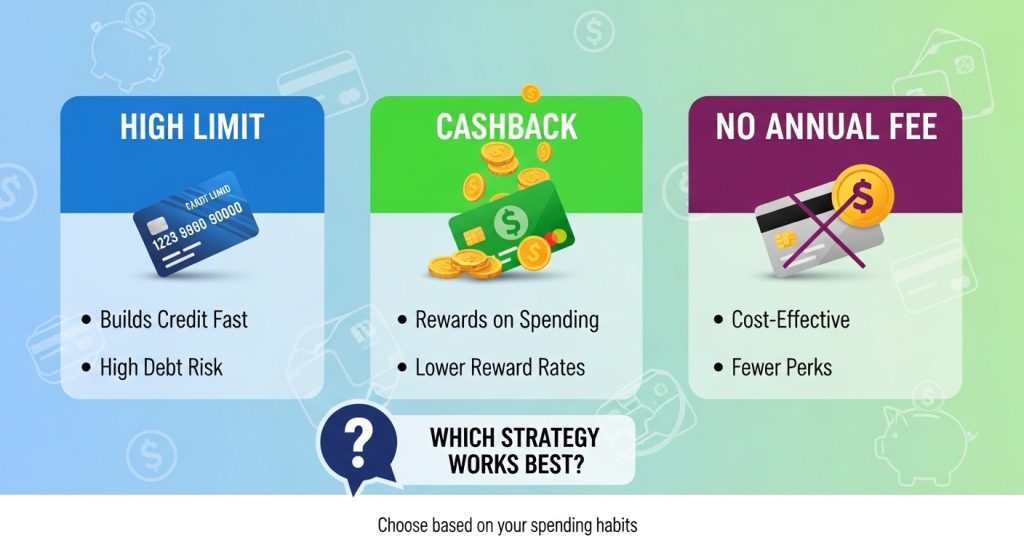
Now that you understand how banks evaluate applications beyond income alone, the logical progression is to examine which type of credit card strategy aligns best with your profile.
Should you prioritize higher limits?
Lower long-term costs?
Cashback incentives?
Each strategy interacts differently with evaluation models.